
Pitched and flat roof insulation: for landlords and owners
Pitched and flat roof insulation work differently, and the wrong method can cause condensation or trap a leak. This page explains each roof type, when to fix the roof covering first, how conservatory roofs fit in, what the new EPC rewards and where funding applies.
Last checked: 21 October 2026.
Book a free retrofit assessment
Pitched and flat roof insulation: which roof do you have?
The roof type decides the method. This table is a quick guide to where the insulation goes and what to watch.
| Roof type | Where insulation usually goes | What to watch |
|---|---|---|
| Pitched roof, unused loft | On the loft floor between and over the joists | Keep eaves ventilation clear |
| Pitched roof, rooms inside | Between and over the rafters | See our room in roof guide |
| Flat roof | On top of the deck under a new waterproof layer | Condensation if fitted underneath |
| Conservatory roof | Replace glazed or polycarbonate panels with an insulated roof | Building control and planning checks |
Where the loft is unused, start with our loft insulation guide. Where rooms sit under the slope, see room in roof insulation.
Pitched roof insulation
A pitched roof is insulated either at ceiling level or along the slope. Ceiling-level work is the simpler, cheaper route. Insulating along the rafters suits roofs where the space is used. Both need the roof covering, gutters and flashings in sound condition first.
Flat roof insulation
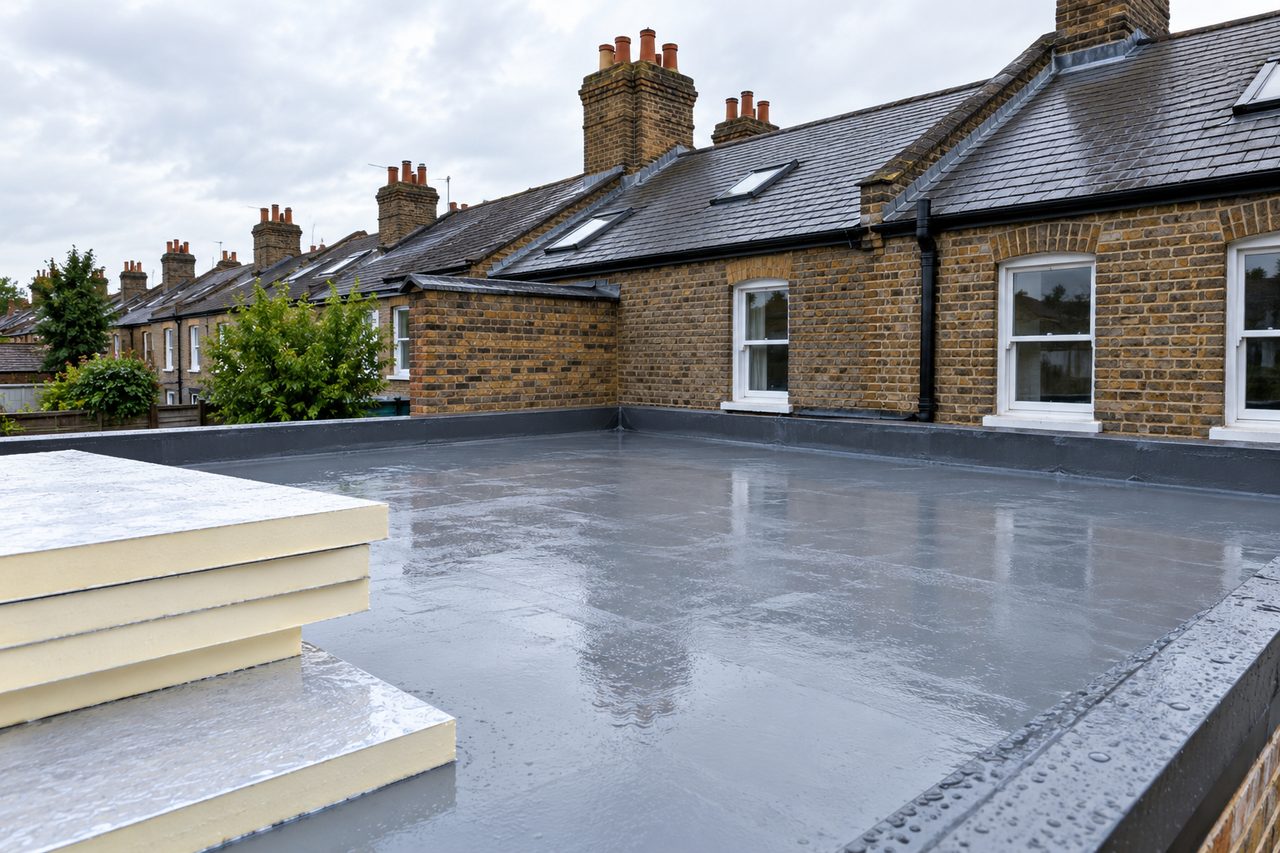
The Energy Saving Trust says flat roofs are ideally insulated from above, with rigid board under a new weatherproof layer. This is usually done when the covering is replaced. Insulation fitted on the underside can cause condensation if not done correctly, so use a professional.
Flat roofs are common on extensions, porches, garages and some terraced backs. Each one is a small area, but the heat loss through a poor flat roof can be large for the room below.
Conservatory roof insulation
A glazed or polycarbonate conservatory roof can lose heat quickly and overheat in summer. Replacing it with an insulated solid roof is the usual fix. Roof changes can bring building control into play, so we confirm the rules at the survey. We do not assume that a conservatory counts the same way on an EPC as the main house.
Roofing for landlords: repair before insulating
Insulation laid over a leaking roof traps water. Rotten timber, slipped tiles and failed flashings must be dealt with first. A roof survey is therefore part of our assessment, not an optional extra.
Good records help here. They show a council or a future buyer that the roof was sound when insulated. Our damp, mould and ventilation guide covers the checks that follow.
How roof insulation affects an EPC
Roof insulation reduces fabric heat loss. Fabric performance is the primary standard on the new EPC, according to the government's response of 21 January 2026. That is confirmed policy, not yet law.
Thresholds are not published, so we quote no points. Our assessor models the effect on your property. A new EPC can also be lower than an old one.
Grant status for roof insulation
Funding depends on the measure. In Greater Manchester, the Warm Homes: Local Grant names loft and room-in-roof insulation. GMCA does not list flat roof insulation or roof repairs by name, so we do not promise funding for them. Measures follow the retrofit assessment.
- Who qualifies: landlords supporting the Good Landlord Charter, with a property rated D or E and an eligible tenant household.
- Amount: 100% for a first property, up to £15,000 for energy performance measures. Later properties receive 50%, up to £7,500.
- End date: none stated by GMCA. ECO4 ends on 31 December 2026.
See grants for landlords for the table. Source: GMCA, checked 21 October 2026.
Cost of roof insulation
Cost depends on roof type, area and access. A flat roof that needs a new covering costs more than one that only needs insulation. Indicative price from £2,500 for pitched roof insulation and from £2,000 for flat roof insulation (UK market research, 2026). This is not a quote: your written quote after a survey is the confirmed price.
You receive a written price after the survey. Spend on measures since 1 October 2025 counts towards the £10,000 cap.
How the process works
- Survey: a retrofit assessor checks the roof covering, structure and ventilation.
- Plan: you receive a written recommendation, which may include repairs.
- Installation: our installer completes the work, with weather protection throughout.
- Records: you receive certificates and photographs for your files.
Who delivers the work
Compliant Lets is a trading name of LAMTANS Holdings Ltd. The work is delivered by LAMTANS Engineering Ltd, which holds PAS 2030, PAS 2035 and TrustMark. Check the registers yourself: TrustMark, RECC, ICO, Gas Safe Register and Simply Certification.
Adviser tip, from a Retrofit Coordinator: if a flat roof is near the end of its life, insulate it when the covering is replaced. Paying for access and waterproofing twice is the costliest way to do the job.
Sources
- Energy Saving Trust: Roof and loft insulation guide, checked 21 October 2026
- GMCA: Warm Homes Local Grant, privately rented scheme, checked 21 October 2026
- GOV.UK: Improving the energy performance of privately rented homes, government response, checked 21 October 2026
Designed & developed by LAMTANS Technologies LLC, USA — part of the LAMTANS Group
Frequently asked questions
Can I insulate a flat roof from inside?
Sometimes, but underside insulation can cause condensation if not done correctly. Insulating from above is usually better when the covering is replaced.
Do I need to replace my roof covering first?
If it leaks or is near the end of its life, yes. Insulation over a failing roof traps moisture and hides the problem.
Is a conservatory roof worth insulating?
It can reduce heat loss and overheating. The right answer depends on how the room is used and joined to the house. We advise at the survey.
Do I need planning permission or building control?
Roof work can need one or both. Rules depend on the type of change and your location. We confirm what applies before work starts.
Is pitched roof insulation the same as loft insulation?
Often yes, when it sits on the loft floor. If the slope is insulated instead, the method is different and the roof space becomes part of the warm home.
Is there a grant for flat roof insulation?
GMCA does not name it among the Warm Homes: Local Grant measures. Loft and room-in-roof insulation are named. Ask us to check your property.
Will the tenant need to move out?
Usually not. Most roof work happens outside or in the roof space. Room-in-roof work is more disruptive, so plan that between tenancies.
How long does flat roof insulation take?
It depends on size and weather. A small roof may take a day or two. We give a programme after the survey.
Can insulation cause roof timbers to rot?
Yes, if moisture is trapped or vents are blocked. That is why we check the roof first and keep ventilation open.