
Room in roof insulation: for landlords and owners
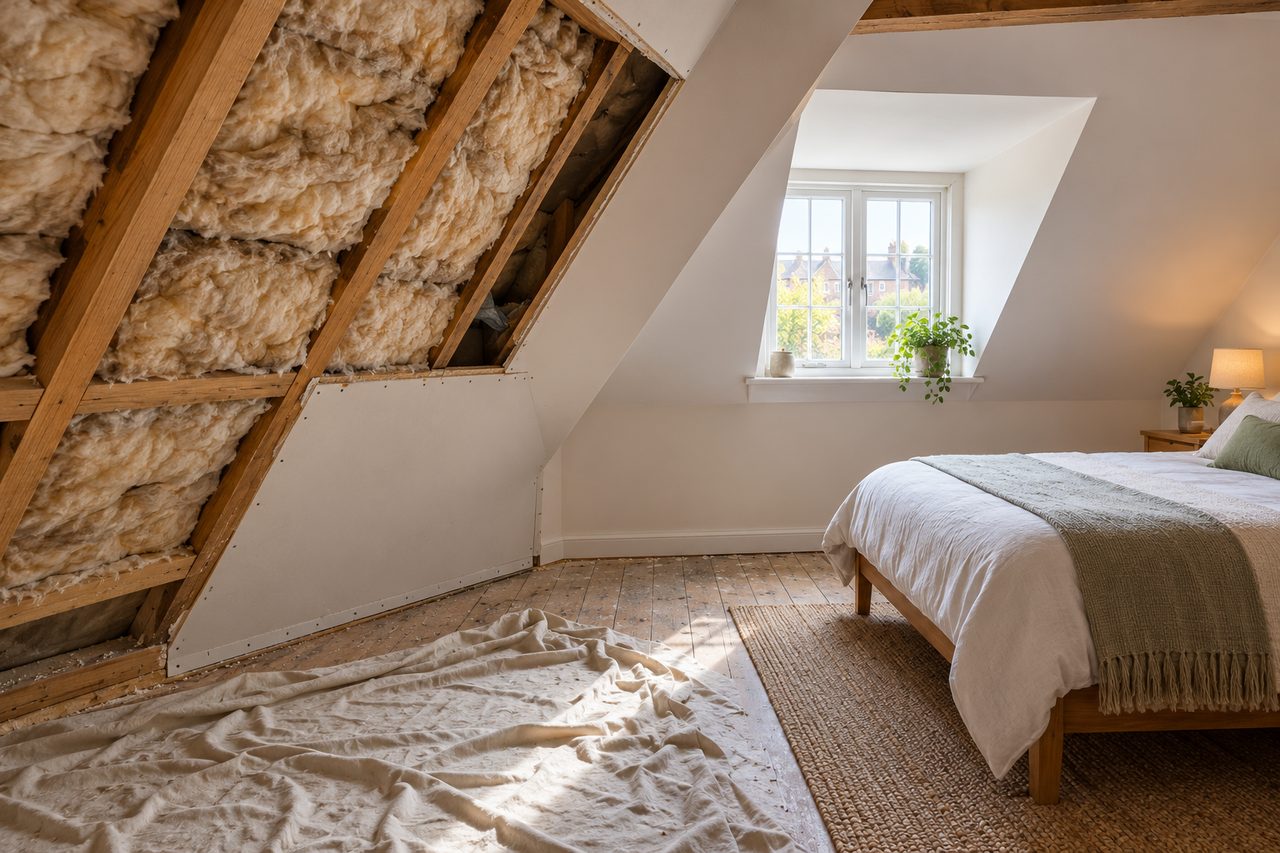
Room in roof insulation covers attic bedrooms and loft conversions, where people live under the slope of the roof. These rooms lose heat through several surfaces at once, so the job is more involved than a standard loft. This page explains what is treated, what it costs and how to fund it.
Last checked: 21 October 2026.
Book a free retrofit assessment
What counts as a room in roof?
A room in roof is a habitable space built into the roof void. It may be a converted loft, an attic bedroom or a storey with sloping ceilings. Loft insulation laid on the floor of an unused loft cannot reach it, because the living space sits inside the roof structure.
If your attic is unused, see our loft insulation guide. If the roof is flat, see roof insulation.
Which parts of the room need insulating?
Heat leaves a room in the roof from more than one place. The Energy Saving Trust says insulation typically goes between and over the rafters and on the vertical walls. A thorough job treats every exposed surface.
| Part of the room | What we look at |
|---|---|
| Sloping ceilings (rafters) | Insulation between and over the rafters |
| Vertical knee walls | Insulation behind the short upright walls |
| Flat ceiling section | Insulation above, where there is access |
| Dormer windows | The cheeks and roof of each dormer |
| Gable and party walls | Insulation on these walls, which are easy to overlook |
| Chimney breasts | Insulation on the exposed faces |
Source: Energy Saving Trust, page updated 8 May 2026, checked 21 October 2026. The last column is our survey checklist.
How room in roof insulation affects an EPC
Treating these rooms improves fabric performance, the lead measure on the new EPC under confirmed policy that is not yet law.
Without published bands, any promised points would be guesswork. The Energy Saving Trust adds that rafter-level insulation is less energy-efficient than a standard loft layer. So we model your attic room first and show you the result.
Loft conversion insulation: what to check first
Many loft conversions were built decades ago. Some have little or no insulation behind the plasterboard, and records may be missing. Our assessor looks for:
- Whether the conversion has building control sign-off.
- The condition of the roof covering above.
- Signs of condensation, mould or staining on sloping ceilings.
- Fire safety, such as smoke alarms and escape routes.
Records matter. If the paperwork is missing, say so at the start so the assessor can plan the survey.
Sloping ceiling insulation and the disruption involved
Sloping ceiling insulation often means removing the plasterboard, fitting insulation and replacing the lining. The room needs redecorating afterwards. For this reason most landlords schedule the work between tenancies.
A trained installer is needed. This is not a job for general roll-out insulation. Poor fitting leaves gaps that let warm air reach cold timber and condense.
Damp, condensation and ventilation
Sealed-in moisture is the main hazard here. It can show up as condensation on the slope, mould in corners or decay in hidden timber. Existing damp is cured before insulating, and roof vents stay open. See the damp, mould and ventilation guide.
Room in roof insulation grants in Greater Manchester
Room-in-roof insulation sits on the measure list of the Warm Homes: Local Grant, run by GMCA.
- Eligible landlords: those signed up to the Good Landlord Charter.
- Eligible homes: rated D or E, with a tenant on a qualifying income or benefit route.
- Funding: a first property is covered in full to £15,000 for energy performance work. Second and later homes get half, to £7,500.
- Closing date: none given by GMCA. ECO4 stops on 31 December 2026.
The grants for landlords guide holds the full table. Source: GMCA, checked 21 October 2026.
Room in roof insulation cost
The Energy Saving Trust says rafter-level insulation costs more than standard loft insulation. It gives no single figure. Costs depend on the number of dormers, the state of the lining and how much plasterboard must come off.
| Property type | Our price from |
|---|---|
| Terraced house with attic room | Indicative from £4,000, not a quote |
| Semi-detached house with loft conversion | Indicative from £4,000, not a quote |
Our price follows the survey in writing. Where a grant applies, we show your share before work begins.
How the process works
- Inspection: an assessor opens a few points in the lining and checks the structure.
- Scope: a written list names every surface to be treated.
- Fitting: our installer insulates, seals and makes good the finish.
- Handover: certificates arrive for your cap evidence.
Who delivers the work
Compliant Lets is a trading name of LAMTANS Holdings Ltd. The work is delivered by LAMTANS Engineering Ltd, which holds PAS 2030, PAS 2035 and TrustMark. Check the registers yourself: TrustMark, RECC, ICO, Gas Safe Register and Simply Certification.
Adviser tip, from a Retrofit Coordinator: ask any installer to list every surface they will treat, including dormer cheeks and gable walls. A quote that only says "attic insulation" may leave the weakest areas untouched, and you would only find out when the room stays cold.
Sources
- Energy Saving Trust: Roof and loft insulation guide, checked 21 October 2026
- GMCA: Warm Homes Local Grant, privately rented scheme, checked 21 October 2026
- GOV.UK: Improving the energy performance of privately rented homes, government response, checked 21 October 2026
Designed & developed by LAMTANS Technologies LLC, USA — part of the LAMTANS Group
Frequently asked questions
Is room in roof insulation different from loft insulation?
Yes. Loft insulation covers an unused roof space. A room in the roof is lived in, so insulation must follow the slopes, walls and dormers and finish neatly.
Can I do it with a tenant living there?
The room is usually disrupted, because plasterboard may come off and redecoration follows. Most landlords plan it between tenancies.
Will it make the room smaller?
Slightly, if insulation goes inside the lining. Over-rafter systems keep more room but need roof work. The survey sets out the options.
Do I need building regulations approval?
Possibly. Check with your local authority building control, or ask us at the survey. We tell you what applies to your house.
Does this work count towards the £10,000 cap?
Yes, when installed since 1 October 2025, along with any third-party funding. Keep invoices and records.
Is there a grant for room in roof insulation?
Possibly, under the Warm Homes: Local Grant in Greater Manchester, if landlord, home and tenant all qualify. ECO4 closes on 31 December 2026.
How do I know if my attic room is insulated?
Often you cannot tell by looking. A survey can check inspection points. Never assume a converted room was insulated to a good standard.
Does it help with condensation?
It can, because warmer surfaces attract less condensation. But poor installation can cause new problems, so ventilation and fitting quality matter.
Will it get my attic room's home to EPC C?
It helps, since fabric leads on the new EPC. The final result depends on the whole house, which the assessment models.